
|
| You might also like: | Zoom Whales Math Game 3 | Narwhal Quiz Printout | Whale Word Hunt #9 | Whale Anatomy | Narwhal Printout- ZoomWhales.com | Today's featured page: Drawing and Adding Fractions, Printable Worksheets |
 |
EnchantedLearning.com ALL ABOUT WHALES! |
 |
| What is a Whale? | Whale Information Sheets | Anatomy and Behavior | Extreme Whales | Whale Myths | Whale Evolution | Whale Classification | Whale Glossary | Whale Activities | Whale Index |
| NARWHAL Monodon monoceros |
Narwhal Printout Narwhal Quiz Narwhal Connect-the-Dots |
Long ago, narwhal sightings reinforced (or started) the unicorn legends. In medieval times, narwhal tusks that washed ashore were thought to be from the mythical unicorn.
SIZE
SKIN AND SHAPE
HABITAT and MIGRATION
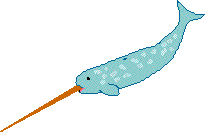 The Narwhal (meaning "corpse whale" in Old Norse) is a rarely seen Arctic whale. This social whale is known for the very long tooth that males have. Very little is known about this whale.
THE TOOTH
All narwhals have two teeth in their upper jaw. After the first year of a male narwhal's life, its left tooth grows outward, spirally. This long, single tooth projects from its upper jaw and can grow to be 7-10 feet (2-3 m) long. Tusks are usually twisted in a counterclockwise direction and have a hollow interior. The tusk's function is uncertain, perhaps used as a formidable jousting weapon in courtship and dominance rivalry, in obtaining food, and/or for channeling and amplifying sonar pulses (which they emit). The tusk is not used in hunting. Tusking is a behavior in which male narwhals rub their tusks together - perhaps determining dominance in the group.
Narwhals can grow to be about 16 feet (4.9 m) long (not counting the tooth), and weigh about 1.8 tons (1.6 tonnes). Females are slightly smaller, averaging about 13 feet (4 m) long, and weighing 1 ton (0.9 tonnes). At birth, narwhals are about 5 feet (1.5 m) long and 175 pounds (80 kg).
Narwhal means "corpse whale" in Old Norse; this is perhaps a description of their skin, which is bluish-gray with white blotches (young narwhals are brown). Narwhals have a cylindrical body (with no dorsal fin) and a round head with a small mouth on their blunt snout. This compact body shape plus a thick layer of blubber retains heat in the icy Arctic waters in which they live.
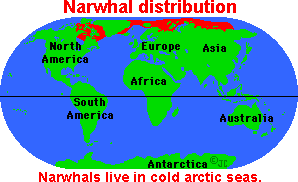
Narwhals live in the icy waters of the Arctic seas. Narwhals winter in deep-water beneath ice pack in groups of 5-10 animals; in summer they migrate to shallow, ice-free summer grounds where they congregate in larger groups. They rarely stray far from ice. In summer they infrequently enter estuaries, deep fjords, and bays.
VOCALIZATION
Narwhals are a very vocal species of whale, making clicks, squeals, and whistles to communicate and/or navigate.
LIFE SPAN
Narwhals maximum life span is about 50 years.
DIET
Narwhals eat fish  , squid
  , shrimp, and other marine animals. They feed near the sea floor, deep under the pack ice of the Arctic.
SOCIAL GROUPS
Pods (social groups of whales) of 4-20 narwhals have been observed; some groups consist of just one sex and others contain both sexes. Many pods may travel together, forming very large groups.
POPULATION COUNT
It is estimated that there are roughly 10,000 to 45,000 narwhals. Narwhals are preyed upon by man (Inuit hunters legally hunt narwhals), polar bears, orcas, sharks, and walruses.
REPRODUCTION
The Narwhal's gestation period is 10-16 months. Calves are brown and have no spots (unlike adults who are blue-gray with whitish spots). Calves are nursed for about 4 months after birth.
CLASSIFICATION
Narwhals (Monodon monoceros) are toothed whales (Suborder Odontoceti). They are one of 76 cetacean species, and are marine mammals.
|
Kingdom Animalia (animals) Phylum Chordata (vertebrates) Class Mammalia (mammals) Order Cetacea (whales and dolphins) Suborder Odontoceti (toothed whales) Superfamily Delphinoidea (oceanic dolphins and some whales) Family Monodontidae (Narwhals and Beluga whales) Genus Monodon Species monoceros |
 |
NARWHAL ACTIVITIES
Narwhal Connect-the-Dots
Narwhal Quiz - or go to the answers
A first grade addition activity. Solve the 1-digit addition problems, then do letter substitutions to find the name of a whale.
A first grade subtraction activity. Solve the 1-digit subtraction problems, then do letter substitutions to answer a whale question.
A Narwhal word hunt activity - For second and third graders.
(and other cetaceans) |
|
BELUGA WHALE
BLUE WHALE BOTTLENOSE DOLPHIN BOWHEAD WHALE GRAY WHALE HUMPBACK WHALE |
KILLER WHALE
MINKE WHALE NARWHAL ORCA RIGHT WHALES SPERM WHALE |
Enchanted Learning®
Over 35,000 Web Pages
Sample Pages for Prospective Subscribers, or click below
|
Overview of Site What's New Enchanted Learning Home Monthly Activity Calendar Books to Print Site Index K-3 Crafts K-3 Themes Little Explorers Picture dictionary PreK/K Activities Rebus Rhymes Stories Writing Cloze Activities Essay Topics Newspaper Writing Activities Parts of Speech Fiction The Test of Time
|
Biology Animal Printouts Biology Label Printouts Biomes Birds Butterflies Dinosaurs Food Chain Human Anatomy Mammals Plants Rainforests Sharks Whales Physical Sciences: K-12 Astronomy The Earth Geology Hurricanes Landforms Oceans Tsunami Volcano |
Languages Dutch French German Italian Japanese (Romaji) Portuguese Spanish Swedish Geography/History Explorers Flags Geography Inventors US History Other Topics Art and Artists Calendars College Finder Crafts Graphic Organizers Label Me! Printouts Math Music Word Wheels |
Click to read our Privacy Policy
| Search the Enchanted Learning website for: |