
|
| You might also like: | Volcano Dictionary: A | Today's featured page: Describe It! Worksheet - Character from a Story |
 Volcano Info |
Volcano Dictionary |
 Volcano Activities and Printouts |
|
| Types of Volcanoes | The Ring of Fire | ||
| A | B | C | D | E | F | G | H | I | J | K | L | M | N | O | P | Q | R | S | T | U | V | W | X | Y | Z |
 radioisotope dating Radioisotope dating is used to find out how old fossils are. Different radioisotopes are used for different geologic time periods because of their different half-lives. |
repose Repose is the time between volcanic eruptions. |
reticulite Reticulite (also called thread-lace scoria) is a very light form of pumice. It is formed during very high fountaining volcanic eruptions, when a lot of air is included in the rock |
Richter scale The Richter scale is a logarithmic scale that measures the intensity of an earthquake. It was developed in 1935 by Charles F. Richter. The magnitude of an earthquake is calculated from the logarithm of the amplitude of waves recorded by seismographs. Beno Gutenberg also contributed to the more general application of the Richter scale. A magnitude 2.0 or less earthquake is called a microearthquake and is not felt by people. A magnitude 4.5 or more earthquake can be measured by seismographs all over the world. |
rift A rift (or graben) is a valley between two faults. |
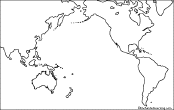 ring of fire The ring of fire is an area around the Pacific Ocean that is high in volcanic, mountain-building, and seismic activity. |
rock A rock is an aggregation of solid matter, a random conglomerate of minerals. The earth's crust is made of rock. There are three types of rock: igneous, sedimentary, and metamorphic. Petrology is the scientific study of rocks. |
rock cycle The rock cycle decribes the relationship between igneous, sedimentary, and metamorphic rocks. James Hutton (1727-1797) first developed the concept of the rock cycle. |
runoff Runoff is water (or other liquids) that drains or flows from the land into streams and rivers, and eventually into the seas. The water is generally from rain or snowpack melt. |
Volcano Info |
Volcano |
Volcano Activities and Printouts |
|
| Types of Volcanoes | The Ring of Fire | ||
| A | B | C | D | E | F | G | H | I | J | K | L | M | N | O | P | Q | R | S | T | U | V | W | X | Y | Z |
Enchanted Learning®
Over 35,000 Web Pages
Sample Pages for Prospective Subscribers, or click below
|
Overview of Site What's New Enchanted Learning Home Monthly Activity Calendar Books to Print Site Index K-3 Crafts K-3 Themes Little Explorers Picture dictionary PreK/K Activities Rebus Rhymes Stories Writing Cloze Activities Essay Topics Newspaper Writing Activities Parts of Speech Fiction The Test of Time
|
Biology Animal Printouts Biology Label Printouts Biomes Birds Butterflies Dinosaurs Food Chain Human Anatomy Mammals Plants Rainforests Sharks Whales Physical Sciences: K-12 Astronomy The Earth Geology Hurricanes Landforms Oceans Tsunami Volcano |
Languages Dutch French German Italian Japanese (Romaji) Portuguese Spanish Swedish Geography/History Explorers Flags Geography Inventors US History Other Topics Art and Artists Calendars College Finder Crafts Graphic Organizers Label Me! Printouts Math Music Word Wheels |
Click to read our Privacy Policy
| Search the Enchanted Learning website for: |