Advertisement.
EnchantedLearning.com is a user-supported site.
As a bonus, site members have access to a banner-ad-free version of the site, with print-friendly pages.
Click here to learn more.
(Already a member? Click here.)
Questions about Particular Dinosaurs T
(in alphabetical order)
Q: My second grade class has been looking up dinosaurs. My partner and I have Tenontosaurus. In some books we found that it walked on its hind legs and had short front legs it used at times for feeding. Other books had it as a four footed dinosaur with legs of equal length. Do you know which is correct so we can draw it properly? Thank you for helping us.
from Tommy H., Elverson, PA, USA; March 31, 1998
A: Tenontosaurus' front legs were a little smaller than its rear legs. (Most dinosaurs have smaller arms than legs - Brachiosaurids are one notable exception.) Tenontosaurus was a very large (24 feet long and about1 ton in weight) hypilophodontid, a group of very fast-running dinosaurs. Most hypsilophodontids were a lot smaller than Tenontosaurus and ran on two legs - they also had much smaller arms than Tenontosaurus. Although it probably ran on two legs, Tenontosaurus was large and bulky and probably spent most of its time on four legs, grazing.
Q: I have to do a report on Thecodontosaurus for my class. I am unable to find any information. Could you help me? Maybe guide me to some information. I am in second grade. Thank you!
from Jared, Burlington, WI, USA; March 16, 1998
A: Thecodontosaurus (meaning "socket-toothed lizard") was a very early dinosaur from the late Triassic period. This was around the time that the dinosaurs were just starting to appear. Thecodontosaurus ate plants and was about 7 feet (2.1 m) long. It had a small head, large thumb claws, long legs, a relatively short neck, short arms than legs, and a long tail. It could probably walk on two or four legs, perhaps grazing and walking on all fours, but running on two legs. It had blunt teeth with serrated edges. It had four toes on each leg and five fingers on each hand.
Fossils have been found in England (near Bristol), which was probably dry and desert-like when Thecodontosaurus lived. Thecodontosaurus is classified as a saurischian (a "lizard-hipped" dinosaur), a sauropodomorpha (usually quadrupedal herbivores), a prosauropod (an early, dead-end branch of the sauropodamorphas), and an Anchisaurid (the earliest prosauropods).
Q: I heard that a therizinosaurus was found with feathers. Is this true?
from Donya Q., Marshall, VA, USA; October 9, 1998
A: Therizinosaurus is a very poorly known dinosaur - in fact, it was first thought to be a turtle. I've never heard of any Therizinosaurus fossils being found with feathers. For information on Therizinosaurus, see the Dinosaur Dictionary under "T."
Recently, some feathered dinosaurs have been found in China, including Caudipteryx, Sinosauropteryx, and Protarchaeopteryx.
Q: Please Give me a lot of info on the titanosaurus.
from Evan F., Charleston, SC, USA; December 2, 1998
A: There's any entry on Titanosaurus in the Dinosaur Dictionary.
Q: Could you please tell me some info about these two dinos: Procompsognthus and Titanosaurus.
thanks
from Maverick, Missouri, USA; December 7, 1998
A: There are entries for these two in the Dinosaur Dictionary, just look under "P" and "T."
Q:could you tell me about titanasaur or cicaradontasaur
from Jonathan, Dalton, Georgia, USA; Feb. 3, 1998
A: Titanosaurus (meaning "titanic lizard") was one of the last giant Sauropods and lived during the late Cretaceous. Not that much is known about Titanosaurus or its relatives, the Titanosauridae, the armored Sauropods. It had a long neck, small head, blunt teeth, and a long counterbalancing tail. Titanosaurus was about 40-60 feet long. It was an herbivore. Only incomplete fossils have been found.
I can't find any references to cicaradontasaur.
Q: Do you have any information on Lesothosaur, Mamenchisaurus, or Titanosaurus?
Please send me all the info you have on them,and pictures
from Heather M., Cumberland, West Virginia, USA; April 30, 1998
 A: I have an information sheet on Lesothosaurus - click here to see it.
 Mamenchisaurus was a long-necked, long-tailed, quadrupedal, plant-eating sauropod from the late Jurassic period, about 156 to 145 million years ago. It was about 70 feet (21 m) long. Mamenchisaurus had the longest neck of any known dinosaur, about 46 feet (14 m). It had 19 vertebrae in its spine, more than any other known dinosaur. Mamenchisaurus was named by Chung Chien Young, a Chinese paleontologist, in 1954. Fossils have been found in China. Mamenchisaurus may be closely related to Diplodocus.
Titanosaurus was another large sauropod, having a long neck, long tail, and small head. It walked on four legs, ate plants and had a heavy body with armor on its back. It was about 40 feet (12 m) long and lived during the late Cretaceous period. It is only known from incomplete fossils. Fossils have been found in India, Europe, and perhaps South America. Titanosaurus was named by British paleontologist Richard Lydekker in 1877.
Q: what family does the Trachodon belong to?
from Harry D., South Orange, New Jersey, USA; December 298, 1998
A: Trachodon was probably a Hadrosaurid, but this is not certain, since Trachodon is only known from a single fossilized tooth.
Q: Do you have some pictures of the fossils of the Trachodon?
from Karen, Lexington, Mass., USA; December 2, 1998
A: No. Trachodon is only known from some fossilized teeth and fragmentary jaw. It's existence as a separate genus is doubtful, and its classification is unsure. It was probably a hadrosaur (but may have been a ceratopsian).
Q: I am in second grade. I have to do a report on Trachodon for my class.
I am unable to find any information in the library. Could you help me
find the size,possible color,what it ate,its enemies,where it lived....? Maybe guide me to some information.
Thank you
from Stanley, Glendora, California, USA; November 13, 1998
A: There's information on Trachodon in the DInosaur Dictionary. Trachodon is only known from a few fossilized teeth, so many details about the dinosaur are not known (like size and weight). THere is no coor information about any of the dinosaurs.
Q: am trying to find information on the Trachodon. Does it have another name? Can you recommend a website?
Ronnie
from Ronnie K., Bliss, NY, USA; May 1, 1998
A: Trachodon (meaning "rough tooth") is a plant-eating dinosaur that is known only from a few teeth found in Montana, USA! It dates from the late Cretaceous period, about 77-73 million years ago. From the teeth, it has been surmised that it was probably a duck-billed dinosaur. It was named in 1856 by Joseph Leidy. There's an interesting page on Trachodon at Dinosauria.com.
Q:My Second Grade class is presently working on Dinosaur Reports.We were unable to find sufficient information on the Trachodon, the Ultrasaurus,and the Seismosaurus. Could you give us some information particularly about their appearance,defence mechanisms and any other information pertaining specifically to these dinosaurs.
from Sunita S., Warsaw, Poland; Feb. 13, 1998
A: Trachodon (meaning "rough tooth") was named based on teeth that were found in Montana, USA. It was a duck-billed dinosaurs. It used to be considered to be the same as Anatosaurus (meaning "duck lizard"), a duck-billed dinosaur (hadrosaur) from the late Cretaceous period. Anatosaurus was an herbivore with a flat head, ran on two legs, had webbed hands, and had up to 1,000 teeth in a horny bill. It was about 15 feet (4.4 m) tall, 30 feet (9 m) long, and weighed about 3.5 tons. Many fossils of Anatosaurus have been found in England and the USA.
Ultrasaurus (meaning "huge lizard") was a huge, late Jurassic Sauropod,100 feet long (30 m), and weighed over 80 tons, and perhaps up to 130 tons. It was a quadrupedal herbivore. It is known from an incomplete fossil found in the US.
Seismosaurus (meaning "Earth-shaking lizard") was another huge, late Jurassic Sauropod, about 120+ feet long (37 m), 18 feet tall (5.5 m), weighing over 80 tons. It was a quadrupedal herbivore, and may be the longest dinosaur.
Q: How long was Triceratops?
from Phyllicia S., Nebraska City, Nebraska, USA; December 1, 1998
A: About 25 feet (8 m) long. For more information on Triceratops, click here.
Q:What were the Triceratops enemies and prey?
from Ryan P.; November 18, 1997
A: T. rex lived at the same time as Triceratops and may have preyed upon them. Triceratops was a plant-eater, and probably ate cycads.
Q: Could you send me a size comparison chart of a Triceratops along with some of the names and information of some plants and other dinosaurs that shared the same time frame with the triceratops as soon as you can because my report is due on May 13,1998.
Thank You,
Nichole
from Nichole L., Loxahatchee, FL, USA; May 10, 1998
A: Click here for my information sheet on Triceratops that will answer your questions.
Q: How fast was the Triceratops?
from Janice J., Mjölby, stergötland, Sweden; September 17, 1998
A: I don't know exactly - no one does. Probably the best way of estimating the speed of extinct animals is the equation formulated by R. McNeill Alexander:
Speed (m/sec)=0.25*(stride length)1.67*(leg length)-1.17*(gravitational constant)0.5
For more details about this formula and on dinosaur locomotion in general, see this page.
Q: ?Por que al Triceratops le dicen "Lagarto de garra terrible"?
from Gabriel P., Caguas, Puerto Rico; August 30, 1998
 A: Triceratops name means "Three-horned head." Deinonychus is the dinosaur whose name means "Terrible claw lizard" because it has a huge, knife-like, retractible claw on each foot.
Q: Dear Mr. Dinosaur man- I was wondering how long the Triceratops lived?? I am doing a report on it and I need to know some information about it. Thank you very much!!! Write back as soon as you can.
Sincerely
from Landon H. Age 9, Redwood Falls, Minnesota, USA; November 13, 1998
A: Triceratops lived from about 68 to 65 million years ago (during the late Cretaceous period). For more information on Triceratops, click here. Also, I'm not a man.
Q: how much does a Triceratops weigh?
from Zander L., Hamilton, Ontario, Canada; November 4, 1998
A: Up to 6-12 tons. For more information on Triceratops, click here.
Q: Where did Triceratops live?
from Truett H., Rowlett, TX, USA; August 30, 1998
A: Triceratops fossils have been found in what is now the western United States and Canada. For more information on Triceratops, click here.
Q: what did triceratops eat?
from mike D., Elk Grove, IL, USA; October 22, 1998
A: Triceratops was an herbivore, a plant eater. It probably ate cycads, palms, and other prehistoric plants with its tough, toothed beak.
Q: How much did Triceratops weigh?
from Mike D., Elkgrove, IL, USA; October 16, 1998
A: About 6-12 tons. For more information on Triceratops, click here.
Q: How many different kind of Triceratops are there?
from ???; May 26, 1998
Q:Were there different types of Triceratops?
from Tiffany M. R., Indianapolis, Indiana, USA; Feb. 2, 1998
A: There is some disagreement about this. Some paleontologists (notably Ostrom and Welnhoffer, 1990) believe there is one species, Triceratops horridus. Others believe that there are two (C. Forster, 1996) or more species, including: Triceratops horridus, Triceratops prorsus, Triceratops albertensis, Triceratops ingens, Triceratops alticornis, and perhaps others.
Q: WHAT DO TRICERATOPS EAT
from Chris, ??; June 9, 1998
A: Triceratops was an herbivore, a plant eater. It probably ate cycads, palms, horsetail rushes, and other prehistoric plants with its tough, toothed beak. It could also chew well with its cheek teeth (like other Ceratopsians, but unlike most other dinosaurs). For more information on Triceratops, click here.
Q:Can you tell me everything you know about the triceratops? If not, then can you give me some web pages that have alot of info on the triceratops? Please, I really need this for a school report!Thanks
from Brandi; Niles, MI, USA; November 18, 1997
A: See my page devoted to Triceratops.
Q: Where do Triceratops live
from Marc C., Rizal, Philippines; September 9, 1997
A: Triceratops fossils have been found in the western United States and Canada. The first Triceratops fossil was discovered in Colorado, USA in 1887 by Othniel Marsh and, for a while, was thought to be an extinct buffalo.
Q: What is the Triceratop's social behavior?-------------Also do they migrate?-----If so what types of areas did they migrate to?--------Did they travel in herds or where they loners?----Well I have to go.--- Write back soon!!!!!!!!!!!
from Heather S., Sedalia, MO, U.S.A.; September 7, 1997
A: The social behavior of prehistoric creatures is mostly unknown and deduced from fossil remains. Ceratopsians (which include Triceratops) were probably herding animals. This hypothesis is supported by the finding of bone beds, large deposits of bones of the same species in an area.
Triceratops fossils are found in the northwest of North America, from Colorado to Alberta. It is not known if they were migratory, but if they did it was probably within this area.
Q: I'm doing a report on the Troodon. Can you send me some information on it. Thanks.
from Benny C., Mahtomedi, MN, USA; May 5, 1998
A: Troodon (meaning "wounding tooth") was a human-sized, fast, long-legged bipedal (walked on two legs) meat eater with serrated teeth and long, slim jaws. Troodon lived during the late Cretaceous period, about 76 to 70 million years ago. It may have been the smartest dinosaur, having the largest brain in proportion to its body weight (as smart as a modern bird). It was a theropod about 6 feet (1.75 m) long with a stiff tail. Troodon had large eyes and perhaps had a good sense of hearning. It had a large, sickle-shaped toe claw on its second toe, and smaller ones on the other. It had three long, clawed fingers. Its fossils have been found in Montana and Wyoming, USA, and Alberta, Canada. Troodon belonged to the family Troodontid. Troodon was discovered by Ferdinand V. Hayden in 1855. Troodon was named in 1856 by Joseph Leidy.
Q: I need information on TSINTAOSAURUS.Any information. This is a very hard dinosaur to find.
Iwould really like a picture also.
from Erin A., IL, USA; November 7, 1998
A: Tsintaosaurus is an invalid name for Tanius. There's an entry for Tanius in the Dinosaur Dictionary. I don't have a drawing of Tanius, but it's closely related to Edmontosaurus and was similar physically.
Q: Where did the T-Rex live -- in a cave? or did they just live outdoors?
from Nick G., Hawaii, USA; December 30, 1998
A: Outdoors.
Q: What is the Tyrannaurus's social life?
from Bryan G., St. Charles, Missouri, USA; November 3, 1998
A: T. rex didn't have much of a social life. For more information click here.
Q: I have a brother and I'm trying to help on his report. It's on Tyrannosaurus rex(a.k.a:T-rex).Can you help him?P.S:I'm supposed to do it beacause he's grouded for a week from the computer
from Devon K. Third Grade, Dunbar, Pennsylvania, USA; November 3, 1998
A: Click here for an information sheet on T. rex. There's also a page on T. rex's bones here.
Q: I have a running debate with my sister. Could a T-rex swim? She has refuted everything I have said,so maybe she'll believe you. Thanks.
from James T., Myrtle Beach, SC, USA; November 2, 1998
A: Accoring to M.K. Brett-Surman (1997, The Complete Dinosaur, chap. 24 - a great book, by the way), there are 3 ways that animals can propel themselves in water:
1. Paddling with the arms (T. rex obviously couldn't do this very well)
2. Sculling with the tail (like crocodilians) but only when the tendons in the tail are not too stiff - and theropod tails lacked ossified tendons, so they could be used this way.
3. Paddling with the hind legs (this also could have happened).
But, just because it is possible for an animal to swim doesn't mean that it DID swim (most cats, except tigers, can swim but won't, even when they're after prey).
Q: Did the dinosaurs care for their young?
What lead to there sucess?
Did the dinosaurs go around in groups, or, go around on their own. how do we know this?
What about their skin, was it scales?
I got told that most of the dinosaurs where small. Is this true?
Is there proof that the T Rex was along. What is it?
from Marc R., Heathfield, East Sussex, England; November 1, 1998
A: You'll find the answers to these questions are in the section on Anatomy and Behavior.
Q: What size is a T-rex's heart and eyes?
from DDutcher, Harrisburg, PA, USA; December 10, 1998
A: No fossilized impressions of T. rex's internal organs have been found. Only bones, teeth, and some skin impressions have been found. For more info on T. rex, click here.
Q: During what era did the tyranosaurus live
from Justin C.; December 18, 1998
A: T. rex lived during the Mesozoic Era (as did all the dinosaurs). It lived from about 68 to 65 million years ago, during the late Cretaceous period.
Q: I remember that a complete dinosaur skeleton was recently sold or auctioned for around $10,000,000.00. How many of these are available and what did the new owners plan to do with it?
from Sammy G., New York, NY, USA; November 25, 1998
A: "Sue" the T. rex recently sold for $5,000,000. It will be displayed at a museum.
There's another tyrannosaurid (70% complete) for sale, "Mr. 'Z.' rex" from Harding County, South Dakota. It's reportedly for sale for ten million dollars.
Q: My quesition were the Tyrannosaurids pure hunters or scavengers.
from Thomas H., Port of Spain, Trinidad and Tobago, USA; November 16, 1998
A: This is a topic of debate right now. It used to be assumed that T. rex was a hunter (and also a scavenger, since most hunters do not turn down a free meal). Paleontologists (notably Jack Horner) have recently begun to question whether T. rex could have been an effective hunter, given its small eyes, puny arms, and relatively slow gait (Note: many other paleontologists think that T. rex had good eyesight and was a relatively fast dinosaur.) Horner's alternative theory is that T. rex scavenged its food from other animals' kills. Scavengers need a good sense of smell (to find meat) and means of long-distance locomotion (to get to the meat). There is evidence that T.rex had an acute sense of smell (deduced from room in its skull for large olfactory lobes in its brain). Also, T. rex's large legs would provide ample means of long-distance locomotion. There are arguments against this scavenger hypothesis. Small eyes do not imply poor vision. Birds (dinosaurs' descendants) have relatively small eyes but acute vision. As for T. rex's puny arms, arms are not necessary for predation; many predators have no arms at all, like sharks and snakes. As for T. rex's gait (speed), there were many animals that were slower than T. rex; these would become its prey, not the speedier types.
Q: WHAT WAS THE AVERAGE LIFESPAN FOR A T-REX?
from Joseph O., Las Cruces, New Mexico, USA; November 13, 1998
A: For a page on the life spans of dinosaurs, click here.
Q: Is the T-rex (in JURASSIC PARK) the same size in real life?
fromJared K., Sparta, TN, USA; November 11, 1998
A: The T. rex in Jurassic Park was about the right size (about 40 feet long and about 20 feet tall). For more information on T. rex, click here.
Q: Is T. rex the most dangerous dinosaur of all time?
from Bradley T., C.A., USA; November 2, 1998
A: It may have been.
Q: What dinosaur did the T.rex eat the most.
from Daniel B., Sacramento, CA, USA; November 19, 1998
A: No one knows. Some T. rex dung was found recently, and it contained some crushed Tricertops bone (from the frill), so this may have been a common meal for T. rex. For more information on T. rex, click here. For an article on the T. rex feces find, click here.
Q: how many years does the t-rex live?
from Sohum, M., Toronto, Ontario, Canada; November 20, 1998
A: No one knows. For a page on dinosaur life spans, click here.
Q: How little was a baby t-rex? Brett T. Nov.21.98
from Brett T., ?; November 21, 1998
A: T. rex hatchlings haven't been found (yet), so no one knows.
Q: What period did t-rex exist in.
from Zach S., Stillwater, Minnesota, USA; November 23, 1998
A: T. rex lived during the late Cretaceous period, about 68 to 65 million years ago. For more information on T. rex, click here.
Q: what are some relatives of T. Rex?
from Jimmy M., cloverdale, ca, USA; November 22, 1998
A: Tyrannosaurus rex's closest relatives are the other members of the genus Tyrannosaurus, which include: Tyrannosaurus bataar, T. efremovi, and perhaps T. novojilovi and T. ancensis (these species are all increasingly smaller than T. rex and have been found in Mongolia and/or China).
Other relatives, a bit more distant, include the Tyrannosaurids: Daspletosaurus, Albertosaurus, Gorgosaurus, Alioramus, and others.
Q: How did the T. rex get it's name?
from Cody C., San Jose, CA, USA; November 30, 1998
A: Tyannosaurus rex (meaning "tyrant lizard king") was named in 1905 by Henry Fairfield Osborn. For more information on T. rex, click here.
Q: IS IT TRUE THAT TYRANNOSAURUS IS THE TALLEST MEAT EATER
from Justin F., Puyallup, Washington, USA; November 30, 1998
A: No, Giganotosaurus and Carcharodontosaurus were slightly taller. Click here for more about this question.
Q: How big were the t-rex teeth?
from Tony M., Grand Rapids, MI, USA; November 30, 1998
A: See the Top Ten Dino Questions.
Q: How big is a T. rex?
from Jaime M. P., Bluefield, West Virginia, USA; May 15, 1998
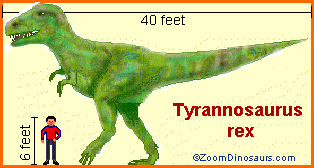 A: Tyrannosaurus rex was about 20 feet (6.2 m) tall (from head to foot) and over 40 feet (12.4 m) long (from snout to tip of tail). For more information on Tyrannosaurus rex, click here.
Q: Do you know how many teeth a T. Rex had?
from Harrison B., West Hartford, CT, USA; October 6, 1998
A: T. rex had about 60 teeth. For an information sheet on T. rex, click here.
Q: WHAT DO YOU CALL A T-REX IN TEXAS?
from ryan .d b., parkesburg, USA; October 9, 1998
A: Tyrannosaurus tex
Q: how big are the t-rex bones in the head?
from ???; March 31, 1998
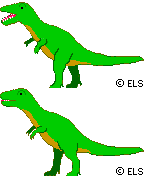 A: Most of T. rex's skull was jaws. These huge jaws were up to 4-feet (1.2 m) long. T. rex had over 60 sharp teeth in these jaws. For more information on T. rex, click here.
 Q:Was there a bigger carnivore than Tyranosaurus Rex ?
from Louis B., London, UK; Oct. 24, 1997
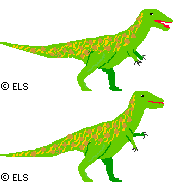
A: Yes. Giganotosaurus carolinii was another theropod that loomed even larger than T. rex.
Q: Hello Zoom Dinosaur peoples! I like your web page and dinosaurs, especially the T-Rex. That's why im doing a report on the T-Rex. I just wanted to know if the T-Rex was a carnivore or a herbivore or an omnivour. Please give me lots and lots and lots and lots of information as soon as possible because my report is due tomorrow. Thanks a lot and I like your web page. ~Have a nice day~ :fi
from Timothy S, Cerritos, CA, US of A; May 26, 1998
A: T. Rex was a carnivore - a meat-eater. For an information page on T. rex, click here.
Q: How long is the T-REX'S TEETH?
from Jonathan, Duluth, GA, USA; October 16, 1998
A: T. rex's teeth were up to 9 inches (23 cm) long. For more information on T. rex, click here.
Q:I know that T-Rex's mated with T-Rex's, but did they also mate with Triceratops too?
from Rachel, El Paso, Texas, USA; Oct. 21, 1997
A: No. They belonged different species (and different genera), making successful mating impossible.
Q: What kind of climate did T-Rex live in? What type of land did T-Rex live on?
from ???; May 17, 1998
A: T. rex lived during the late Cretaceous period, a time of great geological and climate changes. There was a lot of volcanic activity, increased continental drift changed the face of the Earth (the supercontinent Pangaea was breaking up), global cooling and the formation of polar ice and increased seasonal extremes, and finally, a catastrophic asteroid that hit the Earth at the end of the Cretaceous, causing extreme climactic changes (cooling, acid rain, atmospheric gas changes, etc.) and a mass extinction. For more information on the Cretaceous period, click here. For more information on T. rex click here.
Q: Where did T-Rex live in and when? When did the T-Rex become extinct?
from ???; May 16, 1998
A: T. rex fossils have been found in what is now the USA (in Montana, Texas, Utah, and Wyoming), Canada (Alberta and Saskatchewan), and east Asia (Mongolia). T. rex went extinct 65 million years ago in the huge K-T mass extinction. For more information on T. rex, click here.
Q: .Was it possible for a Tyrannosaurus Rex to kill it's own species?
2.Which is bigger, Giganotosaurus Carollini or Tyrannosaurus
3.Did T-Rex hunt or scavenge?
from Muhd Edwan Shaharir, Kuala Lumpur, Wilayah Persekutuan, Malaysia; September 21, 1998
A: 1. Yes - a T. rex could theoretically kill a smaller, weaker, or sick one.
2. Giganotosaurus is a bit taller. Click here for an information sheet on Giganotosaurus.
3. Most hunters are also scavengers. There is a section on this topic in the information sheet on T. rex.
Q: hau big is a t rex ?
hau long ago did the dinousurs daid? HEO LONG CAN A T REX LIVE FOR?
from awhina w., hamilton; June 17, 1998
A: Tyrannosaurus rex was about 20 feet (6.2 m) tall (from head to foot) and over 40 feet (12.4 m) long (from snout to tip of tail). T. rex died out 65 million years ago during a mass extinction in which many other dinosaur species also became extinct. The life span of a T. rex is not known. For more information on T. rex, click here.
Q: Is there any way of telling what colour a T-Rex might have been ?
from Ken P., Sydney, NSW, Australia; June 15, 1998
A: No. Although fossilized T. rex sking has been found, there is no way of determining what color it was. For more information about T. rex, click here.
Q:In which countries of the world, have the bones of a Tyrannosaurus rex been found?
from Elizabeth L., Bavaria, Ohio, USA; Oct. 25, 1997
A: Only about 20 T. rex fossils have been found, mostly in the western part of the United States. A Tyrannosaurus rex fossil was first discovered in 1905 by Henry Fairfield Osborn.
Q: WHAT WAS THE LIFESPAN OF A TYRANNOSAURUS REX ?
from NICOLE AND JOSHUA H., The Rock, N.S.W., Australia; September 15, 1997
A: No one knows the life span of any of the dinosaurs.
Q: What were the Tyrannosaurus's enemies?
from Teddy C., Lake Worth, Florida, USA; May 12, 1998
A: Tyrannosaurus rex was at the top of the food chain when it lived, during the late Cretaceous period. Only the very young, injured and diseased T. rex's were vulnerable to attack from other large predators or groups of smaller predators. For more information on Tyrannosaurus rex, click here.
Q: Where have fossils of T-rex being found in North America?
from Zachary, Aurora, Colorado, USA; March 2, 1998
Q:During what period of geologic time did Tyrannosaurus exist?
from Oluwashina T., Denver, CO, USA; March 2, 1998
Q:During what period of geologic time did the T-rex exist?
from Shina, Denver, CO, USA; Feb. 27, 1998
A: Tyrannosaurus rex lived during the late Cretaceous period, about 85 to 65 million years ago. Fossils have been found in the western USA (in Montana, Texas, Utah, and Wyoming), Canada (Alberta and Saskatchewan), and Asia (Mongolia).
Click here for an information sheet on T. rex.
Q: Compared to an average man how big is the T-REX  ?
?
from Mark Lorenz A. P., Angono, Rizal, Philippines; August 11, 1997
A:
Q: Was the T-rex afraid of anything?
from Kelly Folk and Jennifer T., San Diego, CA, USA; March 26, 1998
A: The dinosaurs probably hadn't evolved complex emotions like fear - imagine a snake (another reptile) showing fear. But, since T. rex was at the top of the food chain (because it was such an enormous carnivore) it didn't have to be very careful about what animal it encountered. It could only be sucessfully attacked by packs of smaller predators when it was young, sick, or badly injured. For more information on T. rex, click here.
Q: I am writing a school report on Tyrannosaurus Rex and cannot find who were it's enemies and where did it live. Brandon G. 2nd Grade
from Brandon G., Glenmoore, PA, USA; March 19, 1998
A: T. rex was pretty much at the top of the food chain; its enemies were tiny bugs, like bacteria and viruses which could kill it with disease. T. rex fossils have been found in the USA (in Montana, Texas, Utah, and Wyoming), Canada (Alberta and Saskatchewan), and east Asia (in Mongolia). For more information on Tyrannosaurus rex, click here.
Q: How many teeth does a Tyrannosaurus have? How did they really die?
from Angel V., Turlock, CA, USA; March 16, 1998
A: T. rex had up to 60 teeth. T. rex, along with a lot of the late dinosaurs, died during the K-T extinction, 65 million years ago. For more information on mass extinction, click here.
Q: How tall was T-Rex?
from Thomas Y., West Seneca, NY, USA; May 7, 1998
A: Tyrannosaurus rex was about 20 feet (6.2 m) tall (from head to foot) and over 40 feet (12.4 m) long (from snout to tip of tail).
For more information on Tyrannosaurus rex, click here.
A dinosaur's length (from snout to tail) is usually the primary measurement given beacause it is the easiest and most accurate statistic to determine - you just need a fossil skeleton and a tape measure. Other statistics, like height require some assumption to be made about the dinosaur's stance. Most dinosaurs heights are the measured from the ground to their hips. To calculate a dinosaur's height up to its head, you first must determine exactly how it stood - did it hold it's head up high, or part-way up, or maybe down? Until recent decades, paleontologists thought that most dinosaurs had very different stances than they do now.
Q:Is the Tyrannosaurus Rex a scavenger or a predator?
from Murtaugh, USA; Dec. 8, 1997
A: Paleontologists (notably Jack Horner) have recently begun to question
whether T. rex could have been an effective hunter, given its small
eyes, puny arms, and relatively slow gait. An alternative would be that
T. rex scavenged its food from other animals' kills. Scavengers need a
good sense of smell (to find meat) and means of long-distance
locomotion (to get to the meat). There is evidence that T. rex had an
acute sense of smell (deduced from room in its skull for large
olfactory lobes in its brain). Also, T. rex's large legs would provide
ample means of long-distance locomotion. There are arguments against
this scavenger hypothesis. Small eyes do not imply poor vision. Birds,
dinosaurs' descendants, have relatively small eyes and acute vision. As
for T. rex's puny arms, arms are not necessary for predation; many
predators have no arms at all, for example, sharks and snakes. As for
T. rex's slow gait, there were many animals that were slower than T.
rex; these would become its prey, not the speedier types.
Q:what is tyrannosaurus rex's common name?
what is t-rex's coloration?
was t-rex a herd or solitary animal?
from Line, katy, tx, us; Dec. 7, 1997
A: Tyrannosaurus rex's common name is Tyrannosaurus rex; dinosaurs common names and their scientific names are the same. Dinosaur coloration is unknown. T. rex fossils have not been found in mass bone beds, so there is no indication that they lived in groups.
Q: How big was tyrannosaurus rex?
from thomas r., Spring City, Pennsylvania, USA; Dec. 5, 1997
A:
Q:WHERE DID TYRANNOSAURUS LIVE? WHAT PERIOD DID IT LIVE? WHAT DOES IT EAT HOW DOES IT EAT? WHAT KIND OF SKIN DOES IT HAVE? WHAT DOES IT LOOK LIKE?
from Mike J., Batavia, OH, USA; Feb. 8, 1998
A: T rex lived during the late Cretaceous period (85-65 million years ago), was a carnivore ( a meat eater) and may have either killed prey or scavenged meat (there is currently a debate about the source of its meat). It had bumpy skin (fossils of T. rex skin imprints have been found). Click here for a lot more information about T. rex.
Q: WHAT OTHER DINOS ARE IN THE T REX FAMILY? WHAT WAS T REXS ENVIROMENT LIKE?
ANT INFO ON T REXS REPRODUCTION. PLEASE X 1 MILLION. I AM 9 YEARS OLD
from Jade, Perth, West. Australia, Australia; June 2, 1998
A: Tyrannosaurus rex belonged to the family of Tyrannosaurids (meaning "tyrant lizards"). They were large, heavy carnivorous (meat-eating) dinosaurs that walked on two strong legs, had long teeth, had tiny arms with 2 fingers and long claws. They lived during the late Cretaceous period. Other Tyrannosaurids include Albertosaurus, Tarbosaurus, Alectrosaurus, Shanshanosaurus, Stygivenator, Alioramus, Chingkankousaurus, Daspletosaurus, Maleevosaurus, Tyrannosaurus rex, Siamotyrannus, and many others.
Q: How big was the biggest tyrannosaur ?
from Renato C., Windsor, Ontario, Canada; August 11, 1997
A: The biggest species of Tyrannosaurid is Tyrannosaurus rex, the "Tyrant Lizard King." The largest specimens of T. rex are about 40+ feet (12.4 m) long, and 15-20 feet (4.6-6 m) tall; they weighed 5-6 tons. Their jaws are 4 feet (1.2 m) long with 60 serrated teeth which are 6 inches (15 cm) long.
Q:What colour is the tyrannosaurus? 2. What/who are his enemies?
from ???; Nov. 17, 1997
A: No one knows what color Tyrannosaurus rex or any other prehistoric, extinct creature was. People guess that they had coloration similar to other reptiles, but that is just speculation.
T. rex's main enemies were probably bacteria and viruses. Very few other animals could do serious damage to this huge carnivore. Although the horned Triceratops, which was probably hunted by T. rex, could probably injure T. rex, it could hardly be called an enemy.
Q:My name is Jenny Ghents. I am in the 2nd grade at Garfield Elementary School. I am interested in dinosaurs of all kinds. We are going on a field trip to the Mammoth site in Hot Springs, SD. I am very excited about that. What I would like to know is why do Tyranasaurus rexs' eat meat?
from Jenny, Hot Springs, SD; Feb. 9, 1998
A: Every animal evolves to fit in a particular ecological niche. T. rex is naturally designed to eat meat; it had large, sharp teeth in huge jaws to tear up meat, clawed feet, a fast pace (possibly for catching prey), large eyes (to find prey), etc. Even if it tried to eat plant material, it would have a hard time. To eat and digest plants, it would need flatter teeth for grinding up the plants, a larger and differently-designed gut to digest the tough plants, etc.
Q:How big are a T-Rex's feet?
from Bobby M., Mechanicsville, Virginia, USA; Feb. 19, 1998
A: T-Rex's feet were massive, about 2-4 feet (0.6-1 m) long. Its toes had claws that were up to 8 inches (20 cm) long.
Return to the top of the page.
Enchanted Learning®
Over 35,000 Web Pages
Sample Pages for Prospective Subscribers, or click below
Click to read our Privacy Policy
Enchanted Learning Search
|
Search the Enchanted Learning website for:
|
Advertisement.
Advertisement.
Copyright ©1997-2018
EnchantedLearning.com ------ How to cite a web page


