



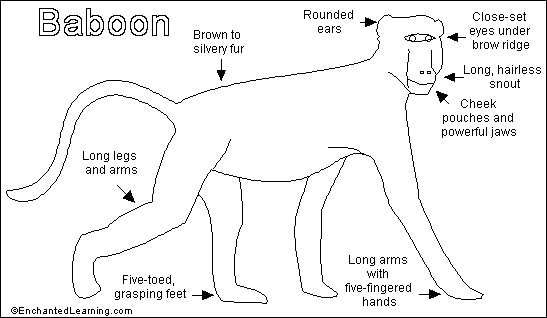
The Baboon is the largest type of monkey. It is a noisy, ferocious, ground-dwelling Old World monkey that lives in groups called a troop (or a congress). Troops vary in size from a few individuals to up to several hundred members.
Distribution and Range: Baboons live in savannas, open woods, grasslands, rocky areas, and dry lands, in Africa and on the Arabian Peninsula. These intelligent primates are endangered due to loss of habitat.
Anatomy: Baboons have a large, muscular body with gray to brown fur. The face and buttocks are hairless and sometimes brightly colored. The female has duller colors than the male. The largest species of baboons grow to be about 35 inches (90 cm) long. Baboons weigh from 30 to 100 pounds (14 to 45 kg). Males are larger than females and have large, pointed canine teeth. Baboons have cheek pouches and a dog-like face.
Diet: Baboons are omnivores (they eat both plants and meat). They eat grasses, roots, insects and other small animals, including lizards, small mammals, and snakes.
Predators: Leopards, cheetahs, wild dogs, and people hunt the baboon. When a baboon is threatened by a predator, it will run away or bark loudly and bare its large teeth.
Classification: There are many different species of baboons. Class Mammalia (mammals), Order Primates, Family Cecropithecidae (Old World monkeys), Subfamily Cercopithecinae (baboons, macaques, guenons, and mangabeys), two genera [Papio, Theropithecus].