Advertisement.

EnchantedLearning.com is a user-supported site.
As a bonus, site members have access to a banner-ad-free version of the site, with print-friendly pages.
Click here to learn more.

Join Enchanted Learning
Site subscriptions last 12 months.
Click here for more information on site membership.
$20.00/year or other amount
(directly by Credit Card)
$20.00/year or other amount
(via PayPal)
$20.00/year or other amount
(for sending a check by mail)
$20.00/year or other amount
(for subscribing by school purchase order)
As a thank-you bonus, site members have access to a banner-ad-free version of the site, with print-friendly pages.
(Already a member? Click here.)

EnchantedLearning.com Scallop Animal Printouts
Label Me! Printouts


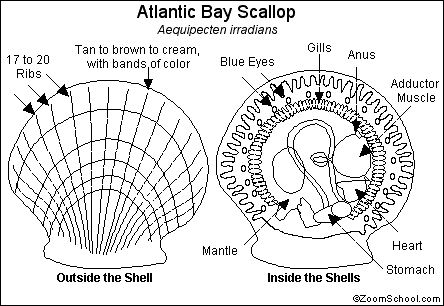
Scallops are bivalves; they have two hard shells and a soft body. They are benthic animals; they spend most of their time on the sea bottom. Scallops mostly stay in underwater grass beds on a soft, shallow sea floor. Scallops use jet propulsion to move; they quickly open and close their shells, squirting the water out of the shells, moving in spurts. These invertebrate animals have a life span of about 1 1/2 years.

Anatomy: The two hard shells (also called valves) are attached by a muscular hinge called the adductor muscle The Bay Scallop is about 3 inches (8 cm) in diameter; other scallops can reach 8 inches (20 cm) in diameter. The shell is secreted by the mantle, which is a thin sheet of tissue located between the shell and the body. Scallops have many primitive eyes; they can only sense changed in light and motion, helping them to detect predators.

Diet: Scallops eat microscopic food, like algae and plankton that floats through the water.

Predators of the Scallop:Many animals eat scallops, including sea stars, crabs, and people.


Enchanted Learning Search

First search engine with spelling correction and pictures!
Search EnchantedLearning.com for all the words:
Enter one or more words, or a short phrase.
You can use an asterisk * as a wild-card.


Advertisement.


Advertisement.


Copyright ©1999-2008 EnchantedLearning.com ------ How to cite a web page