Advertisement.

EnchantedLearning.com is a user-supported site.
As a bonus, site members have access to a banner-ad-free version of the site, with print-friendly pages.
Click here to learn more.

Become a member of Enchanted Learning.
Site subscriptions last 12 months.
Click here for more information on site membership.
$20.00/year or other amount
(directly by Credit Card)
$20.00/year or other amount
(via PayPal)
$20.00/year or other amount
(for sending a check by mail)
$20.00/year or other amount
(for subscribing by school purchase order)
As a thank-you bonus, site members have access to a banner-ad-free version of the site, with print-friendly pages.
(Already a member? Click here.)

All About Birds EnchantedLearning.com
Peregrine Falcon
Animal Printouts
Label Me! Printouts


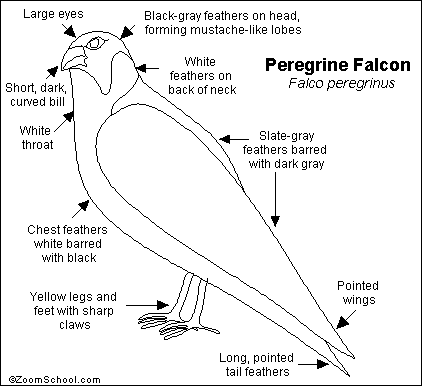
The peregrine falcon is a bird of prey that lives near cliffs and mountains in North America. It is an incredibly fast flyer; it may be the fastest-flying bird (and perhaps the fastest animal). It has been clocked at 90 mph (145 kph) and may fly even faster. The call sounds like "kek, kek, kek."

The female falcon is called the falcon; the male is called the tercel (from the German word terzel, which means one-third, since the male is roughly one-third the size of the female).

Anatomy: Peregrine falcons are about 15 inches (38 cm) long. The female is about 3 inches (7.6 cm) longer than the male.

Diet: Peregrine falcons are carnivores and hunt during the day (they are diurnal). They eat mostly birds, swooping down on their prey or simply overtaking them. They prey on sea birds, pigeons, waders, and other birds.

Eggs and Nests: Peregrine falcon nests are minimal, and are usually on the cliff ledges. Females lay 2-4 red-brown eggs in each clutch (a set of eggs laid at one time).


Enchanted Learning Search

First search engine with spelling correction and pictures!
Search EnchantedLearning.com for all the words:
Enter one or more words, or a short phrase.
You can use an asterisk * as a wild-card.


Advertisement.


Advertisement.


Copyright ©1999-2008 EnchantedLearning.com ------ How to cite a web page