
|
| Go to a Flamingo Quiz More Information on Birds |
EnchantedLearning.com American Flamingo Phoenicopterus ruper |
Animal Printouts Label Me! Printouts |
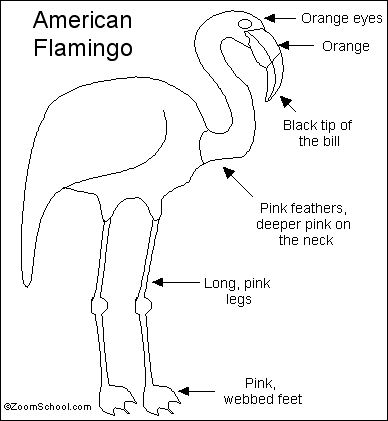 The American Flamingo is a large pink bird that lives in large flocks in wetlands. When a flamingo flies, its long neck and long legs make a nearly straight line. Flamingos live to be about 50 years old.
Feathers: The flamingo's bright pink color is due to its diet. The carotene from the shrimp in its diet turns its feathers pink. If a flamingo's diet is low in carotene, the feathers become white.
Anatomy: Flamingos have a very long neck and long, pink legs with big, pink, webbed feet. The eyes are orange. Adults grow to be about 4 feet (1.2 m) tall. Their long bill turns downward in the middle; it is yellow/orange with a black tip. The large bill is used in filter feeding.
Diet: The flamingo eats insects, crustaceans (shrimp and other shrimp-like animals), and tiny plants like diatoms and algae. The flamingo eats by putting its head upside-down into the water looking backwards. It takes in water that is rich in tiny organisms and filters nutrients from the water with a comb-like organ on its tongue.
Habitat: Flamingos prefer alkaline (the opposite of acid) waters. The American flamingo is native to Central America and South America. These birds live in warm, lush coastal areas and on cold mountain lakes high in the Andes Mountains (in Chile).
| Search the Enchanted Learning website for: |