
|
| You might also like: | Copepod Printout | Great Blue Heron Printout | Great Egret Printout | Muskrat Printout | Shrimp Printout | Today's featured page: White House |
| More Information on Birds | EnchantedLearning.com Crane |
Animal Printouts Label Me! Printouts |
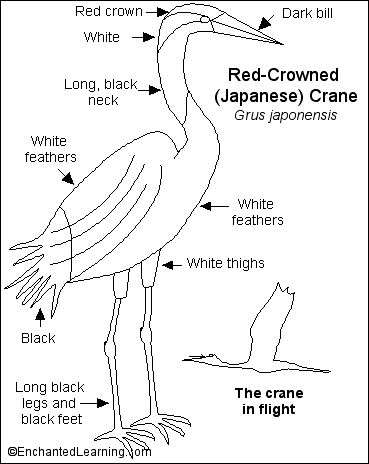 Cranes are large birds that live in wetlands. They use their long legs to wade in shallow water, and use their long neck and sharp bill to kill small animals and obtain some tender plant roots. In order to fly, cranes must get a running start (usually facing the wind). Cranes migrate seasonally; some species fly long distances in order to breed in a cold area and eat in warm area. When cranes migrate, they fly in a "V" formation.
Distribution: Cranes are found in Africa, Asia, Australian, Europe, and North America (there are no cranes in South America).
Symbolism: Cranes have been a symbol of peace, purity, wisdom, fidelity, prosperity, and longevity for thousands of years.
Anatomy: Cranes have a long neck, long legs, long, rounded wings, a long, pointed bill, and a streamlined body. Some cranes have a feathery head crest. Males and females have similar plumage, but the males are larger. The tallest crane is the Sarus Crane (up to 5 3/4 feet = 1.75 m tall); the smallest is the Demoiselle Crane. The heaviest crane is the Red-crowned Crane (weighing up to 24 pounds or 11 kg).
Diet: Cranes are omnivores (they eat animals and plants); their diet includes small animals (like insects, small fish, small birds, and small reptiles) and some plant material (like berries and tuber).
Reproduction: Most cranes mate for life. Crane eggs vary in color from white to light blue (it differs with the species). Most chicks are brown.
| Search the Enchanted Learning website for: |